Certified Payroll Is Where Construction ERPs Quietly Fail
A certified payroll report ends with a signature, not a submit button. On the Statement of Compliance section of Form WH-347, someone at your company certifies that a specific week’s hours, wage rates, classifications, fringe benefits, and deductions are accurate for every worker on a federally funded job, and that the underlying records are complete and available on request. Get that wrong often enough and it stops being a paperwork problem.
Certified payroll, the weekly reporting required on Davis-Bacon and state prevailing wage jobs, is not a payroll run with extra fields. It demands a weekly cadence instead of biweekly, wage rates that shift by trade and county, fringe benefit math with its own annualization rules, apprentice ratios tracked against a registered program, and a report format that depends on which government agency is asking. Most construction ERPs were built around job costing and billing, not around that list, and certified payroll got added later, if it got added at all.
What a Certified Payroll Report Actually Has to Prove
The Department of Labor’s Fact Sheet #66, covering the Davis-Bacon and Related Acts, is direct about the cadence: contractors on covered jobs pay workers weekly and submit weekly certified payroll records to the contracting agency, not monthly, not at the end of the job. Each report covers one project, one pay period, and every laborer or mechanic who touched the site that week.
The document that carries the legal weight is the Statement of Compliance, the signed section of Form WH-347. It is not a summary. Signing it certifies that the payroll data is correct and complete, that the underlying records will be produced on request, that each worker’s reported classification matches the work actually performed, that any apprentices are properly registered in a bona fide program, and that no rebates or improper deductions were taken from anyone’s pay. Five separate certifications, one signature, every week, for the life of the project.
The Department of Labor released an online fillable version of the WH-347 in December 2025, alongside an annotated guide, specifically to cut down on the errors contractors were making on the paper form. Wage and Hour Division Administrator Andrew Rogers framed it as a tool to “improve accuracy, reduce administrative burden, and promote consistent reporting practices across DBRA-covered projects.” The web version is optional. The underlying obligation, submitting accurate weekly data under a signed certification, is not, and has not changed.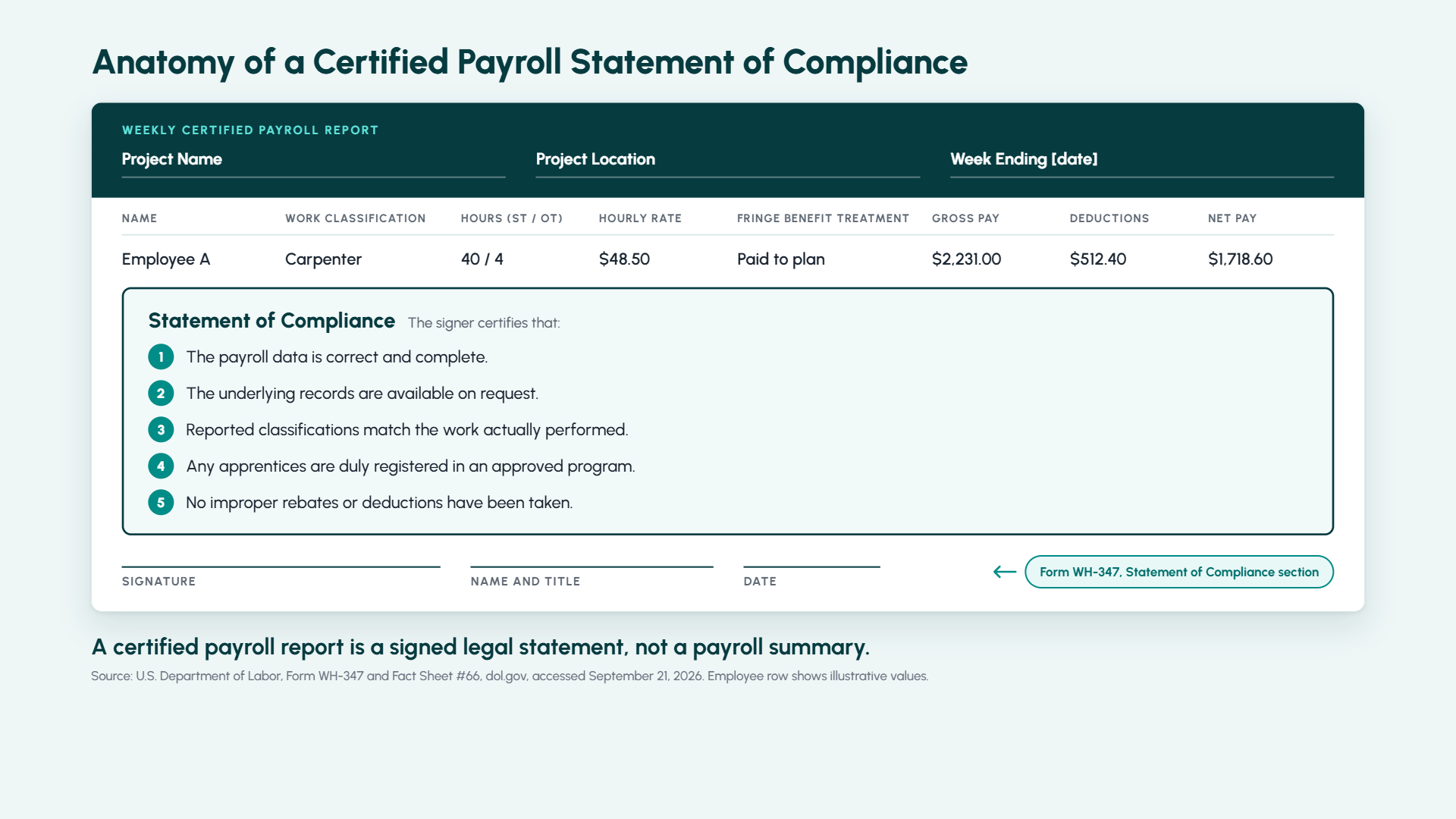
Fringe Benefits Are Where Davis-Bacon Compliance Gets Complicated
A Davis-Bacon wage determination sets a base hourly rate and a fringe benefit rate, and a contractor can satisfy the fringe portion in cash, through a bona fide benefit plan, or some combination of both. That flexibility is useful. It is also where the math stops being simple.
The Department of Labor’s Fact Sheet #66E lays out the mechanics. Credit for a fringe benefit plan is based on the annualized rate of contribution, meaning a contractor has to average what it pays into that plan across all hours an employee works during the year, Davis-Bacon and non-Davis-Bacon hours alike, not just the hours on the certified job. Benefits expressed as a percentage of the base rate do not automatically carry into overtime calculations the same way cash wages do. A contractor’s own administrative cost of running the benefit plan is not creditable against the fringe obligation. And whether a given payment counts as a fringe benefit or as straight wages changes how overtime gets calculated on that check.
None of that shows up as a validation error in a general ledger. A payroll system built for a standard biweekly cycle has no built-in reason to track annualized contribution rates or flag a benefit that is structured as a percentage instead of a flat dollar amount. It just runs the numbers it is given.
Apprentice Ratios Are a Prevailing Wage Reporting Trap
Apprentices can legally be paid less than the prevailing wage rate on a covered job, but only inside a specific limit. Department of Labor guidance is precise about it: an apprentice can be paid below the wage determination rate only if the ratio of apprentices to journey workers on site does not exceed the ratio set by the apprentice’s registered program, or by the standards for the locality where the project sits, if that differs from where the program is registered.
That is a headcount rule, tracked daily, on a jobsite where crews move between tasks and subcontractors bring their own people. Exceed the ratio and the apprentices working above it are owed the full journeyworker rate retroactively, not a warning. Most systems that track labor hours were not built to flag a ratio breach in real time. They log hours by employee and classification, and the ratio math happens later, if it happens at all.
Why the WH-347 Form Isn’t the Only Certified Payroll Form
Federal contractors have used Form WH-347 for decades, and the Department of Labor gave it its first real interface update in December 2025: an online fillable version at dol.gov, built to catch the errors contractors made filling in the PDF by hand. It works in a browser, nothing gets installed, and the department says the data stays on the user’s machine rather than a DOL server. The older PDF is still valid. Using either version is optional; submitting accurate weekly certified payroll is not.
States were not waiting on Washington to modernize their own systems. California has required contractors on public works to file through its own electronic certified payroll reporting system, eCPR, since January 1, 2016, and the federal WH-347 does not enter into it at all. New York went further in the other direction. Starting January 1, 2026, contractors and subcontractors on New York public work and on many privately funded prevailing wage projects have to submit certified payroll through a new state portal at least every 30 days, with a $100-per-day penalty kicking in after a 14-day grace period for late submissions, and separate criminal exposure for knowingly false records.
Three governments, three different systems, three different cadences and formats, and that is before a contractor works across county-level or agency-specific wage determinations on top of it. A construction ERP that assumes certified payroll means one form, filled out one way, is already behind.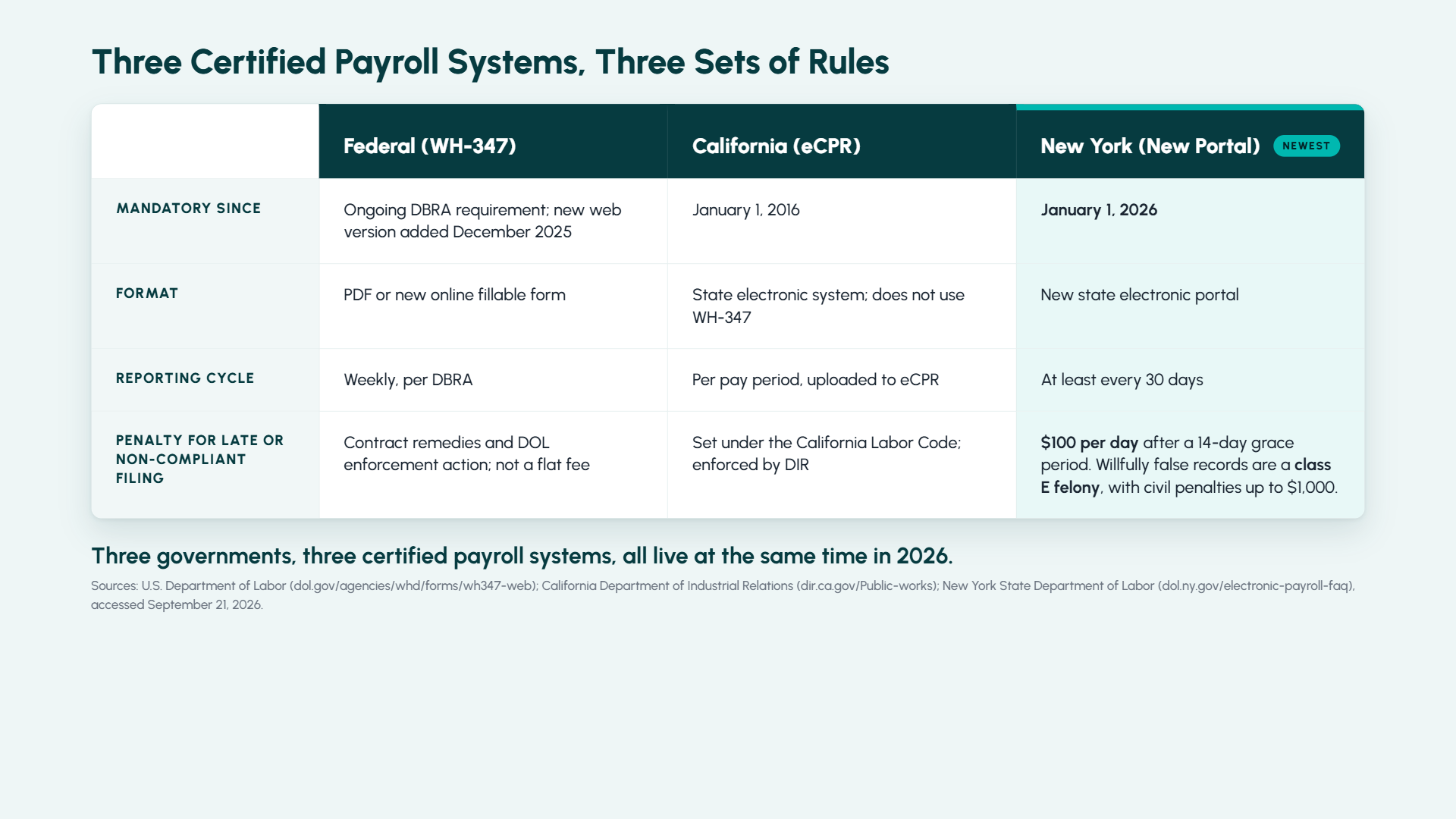
What DOL’s Enforcement Numbers Actually Show
The Department of Labor’s Wage and Hour Division publishes its own enforcement results by act, and the Davis-Bacon and Related Acts numbers for fiscal year 2025 are worth reading carefully, in both directions. WHD closed 641 DBRA compliance actions in FY2025 and found violations in 445 of them, about 69%, recovering just over $26.75 million in back wages for 5,812 employees. In FY2024, WHD closed 765 actions, found violations in 548, about 72%, and recovered $14.1 million for 5,534 employees.
Read those numbers for what they are, not for what they sound like. This is not a survey of the construction industry and it is not a random sample. These are outcomes from cases WHD had already opened, typically because something, a worker complaint, a referral, a targeted review, flagged the contractor for investigation in the first place. A 69% violation rate among investigated cases says something about how hard the details are to get right once an investigator starts pulling records. It says nothing about what percentage of contractors overall are out of compliance, and it should not be quoted that way.
What the two years do show consistently is that when DOL looks, it tends to find something, and the dollar recovery moved up sharply even as the case count went down. That combination, fewer cases opened, more money recovered per case, points to violations that were not small clerical slips.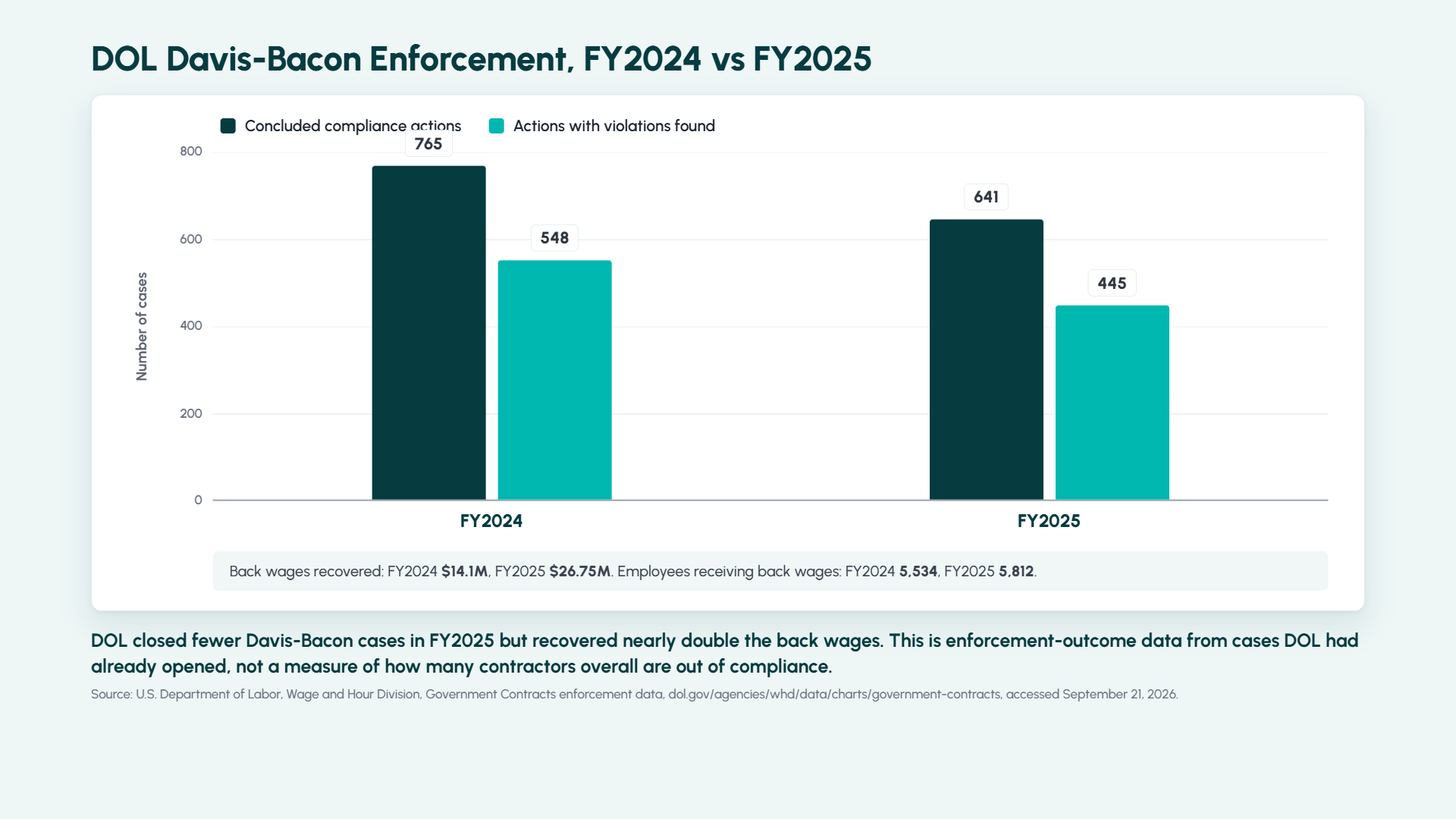
Construction ERP Compliance: Where ProjectPro Fits
ProjectPro, Netsmartz’s construction ERP built on Microsoft Dynamics 365 Business Central, does not run payroll, and says so plainly on its own product pages. It works alongside outsourced payroll providers rather than replacing them, naming integrations with ADP, Paychex, Paylocity, Paycor, and Miter, plus a tighter path to Integrity Data’s Payroll NOW for firms that want payroll running inside Business Central itself. Fringe benefits, tax withholding, and the actual filing work stay with whichever payroll partner a contractor uses. In that sense, ProjectPro is not certified payroll software in the way a standalone payroll engine is: it does not calculate or file on a contractor’s behalf.
What ProjectPro is built to do sits on either side of that payroll run. On the front end, it maps labor codes to project wage rates by location and classification, so hours get categorized correctly (straight time, overtime, fringe-eligible or not) before they ever reach the payroll system. On the back end, once the payroll partner has calculated actual pay, fringes, and overtime, that data reconciles back into ProjectPro’s job cost ledger, so the labor burden on a certified payroll job shows up correctly against the right cost code. ProjectPro’s own materials describe generating WH-347 and state-format reports from that structured labor data, applying the wage and fringe rules that were set up on the front end.
What that does not mean is auto-filing with a state agency. Nothing in ProjectPro’s public materials claims a direct integration with California’s eCPR system or New York’s new portal specifically, and a contractor using either state’s system should confirm the export format and filing process with their implementation team rather than assume it is handled. The honest version of this story is data readiness and reporting structure, not a payroll engine and not a state filing service.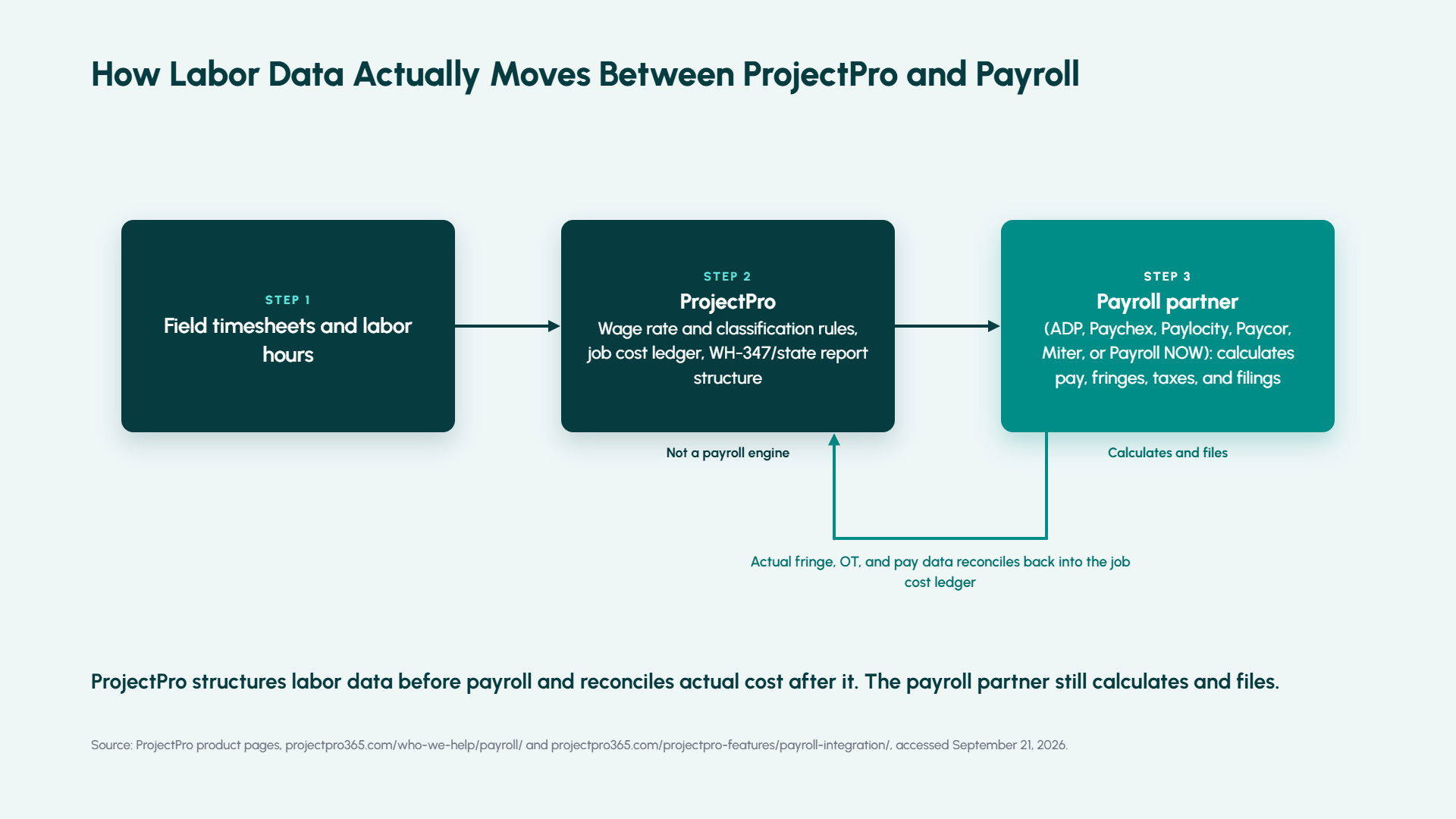
The Signature Is the Risk
Every certified payroll report still ends the same way it did when Form WH-347 was a typewritten page: someone signs it, and that signature is a legal statement, not an administrative formality. What changed in the last year is how many different systems that signature now has to satisfy: a federal web form that is optional but does not replace the underlying weekly obligation, a California system that has run independently for a decade, and a New York portal that started enforcing its own 30-day cycle and daily penalty on January 1, 2026.
For a CFO or controller, the practical question is not whether an ERP claims to handle certified payroll. It is whether the wage rates, classifications, fringe treatment, and apprentice ratios feeding that report are correct before anyone signs anything, and whether the system can prove it if an investigator asks. That is a data problem before it is a compliance problem, and it is worth auditing before the next bid, not after the next investigation.
Next Step
If certified payroll reporting on your Davis-Bacon or prevailing wage jobs still runs on spreadsheets, or on wage and classification data nobody fully trusts before it reaches payroll, it is worth a short conversation about what a structured job cost and wage data setup looks like in ProjectPro. Talk to the ProjectPro team to walk through your current process before your next audit or bid.
FAQs
Certified payroll is the weekly wage reporting required on federal Davis-Bacon projects and most state prevailing wage jobs. Each week, a contractor reports every covered worker’s hours, classification, wage rate, and fringe benefit treatment for that specific project, then signs a Statement of Compliance certifying the data is accurate and complete.
A normal payroll run pays employees on whatever cycle a company uses, often biweekly, and reports wages in aggregate. Certified payroll requires weekly reporting tied to a specific project, wage rates set by a government wage determination rather than a company’s standard pay scale, and a signed legal certification, not just a pay stub.
No. Some states accept the federal WH-347 form or a close variant, but others run entirely separate systems. California has required contractors to file through its own eCPR system since January 1, 2016, and New York started requiring submissions through a new state portal on January 1, 2026. A contractor working across state lines may need to satisfy more than one format inside the same company.
It is the signed certification section of Form WH-347, or the equivalent on a state form. Signing it certifies that the payroll data for that week is correct and complete, that supporting records are available on request, that reported classifications match the work performed, that any apprentices are properly registered, and that no improper deductions were taken from workers’ pay.
Generally, no. Certified payroll software and construction ERPs typically manage job costing, wage classification, and report generation, while a payroll provider, such as ADP, Paychex, or Paylocity, calculates actual pay, withholds taxes, and handles fringe benefit contributions. The two systems are meant to work together, with labor data flowing one way and actual pay and fringe data reconciling back the other way.