
Estimate to Budget Handoff: Your Budget Was Set Before You Won the Job
The day you win a bid, someone opens a new job and types in a budget. In most shops, nobody chooses what goes in. The estimate goes in, because it is the only number anyone has. That is the estimate to budget handoff, and it is a quiet decision with a long tail.
The estimate was built under a deadline, on one person’s judgment, to be competitive. From award day it becomes the yardstick for every cost report, change order and WIP schedule. If it carries a mistake, or a structure that does not match how you code costs, the job starts slightly out of true, and you spend months wondering why the margin keeps slipping.
Where the handoff goes wrong
Three patterns worth checking for your own jobs. They are things to look for, not statistics.
The estimate and the ledger speak different languages. Estimators think in assemblies and bid items. Accounting thinks in cost codes. Somewhere between award and the first purchase order, someone translates one into the other, usually in a spreadsheet, usually once, usually in a hurry. Two jobs with the same scope end up with different budget structures, and nobody can compare them later.
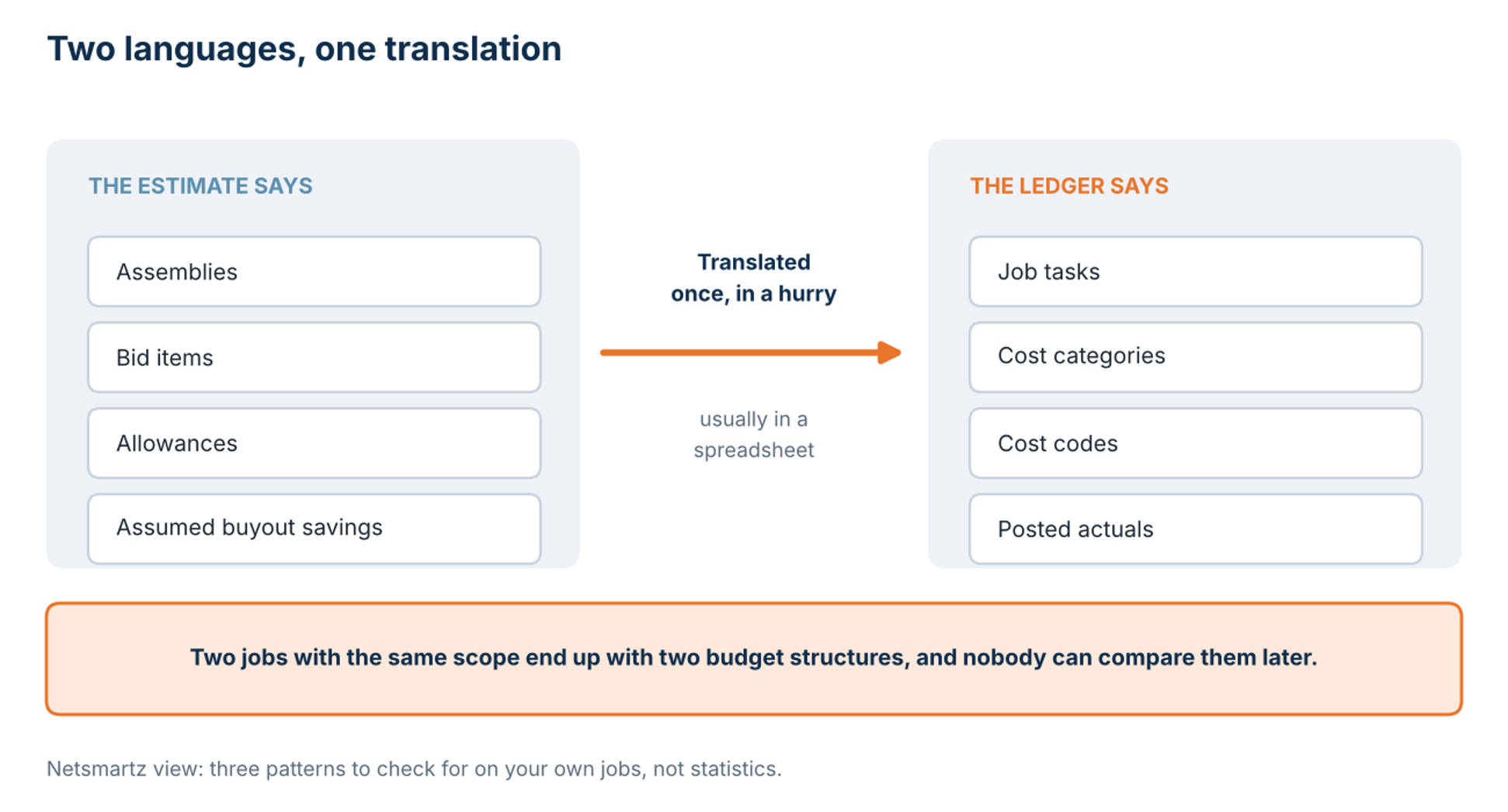
The translation that happens between award and the first purchase order.
The assumptions do not travel. The number makes it into the system. The reasons behind it do not: the allowance carried for a long-lead item, the savings counted on at buyout, the scope excluded from the proposal. Six weeks in, a project manager sees a variance and cannot tell whether it is a problem or just an assumption coming due.
There is no clean baseline to change. The first change order lands, and the question is whether it gets added to the budget or tracked beside it. If the original budget was never frozen, you are amending a moving target.
Underneath all three sits a simpler problem: the handoff has no owner. The estimator feels the job ended at award. Accounting feels it starts when the budget arrives. The project manager inherits whatever lands between them. Nobody is careless. The task simply belongs to nobody.
A small example, invented for illustration. The estimate carries an allowance for switchgear because the supplier has not quoted yet. Six weeks after award the quote comes in higher. If the allowance was never written down, the project manager see an overrun on electrical equipment and starts asking the field what went wrong. If it was written down, the same number is a known assumption coming due, and the conversation is about buyout instead of blame.
An estimate to budget handoff that takes thirty minutes
You do not need new software to try this on your next award.
- Freeze and name the version that won. “Awarded estimate, signed off by [name], [date]” beats “final_v3_revised”.
- Map bid items to job tasks and cost categories once, as a template, not job by job.
- Hold a short review before the first purchase order: estimator, project manager and whoever owns job cost. The estimator’s job in that meeting is to say which parts of the number are soft.
- Write the assumptions down beside the budget: allowances, exclusions, expected buyout.
- Decide in advance how approved changes enter the baseline, so you are not deciding it under pressure.
- At roughly a quarter complete, compare actual margin with bid margin. Sort each gap into three piles: the estimate was off, the handoff dropped something, or site conditions changed. The middle pile is the one you can fix.
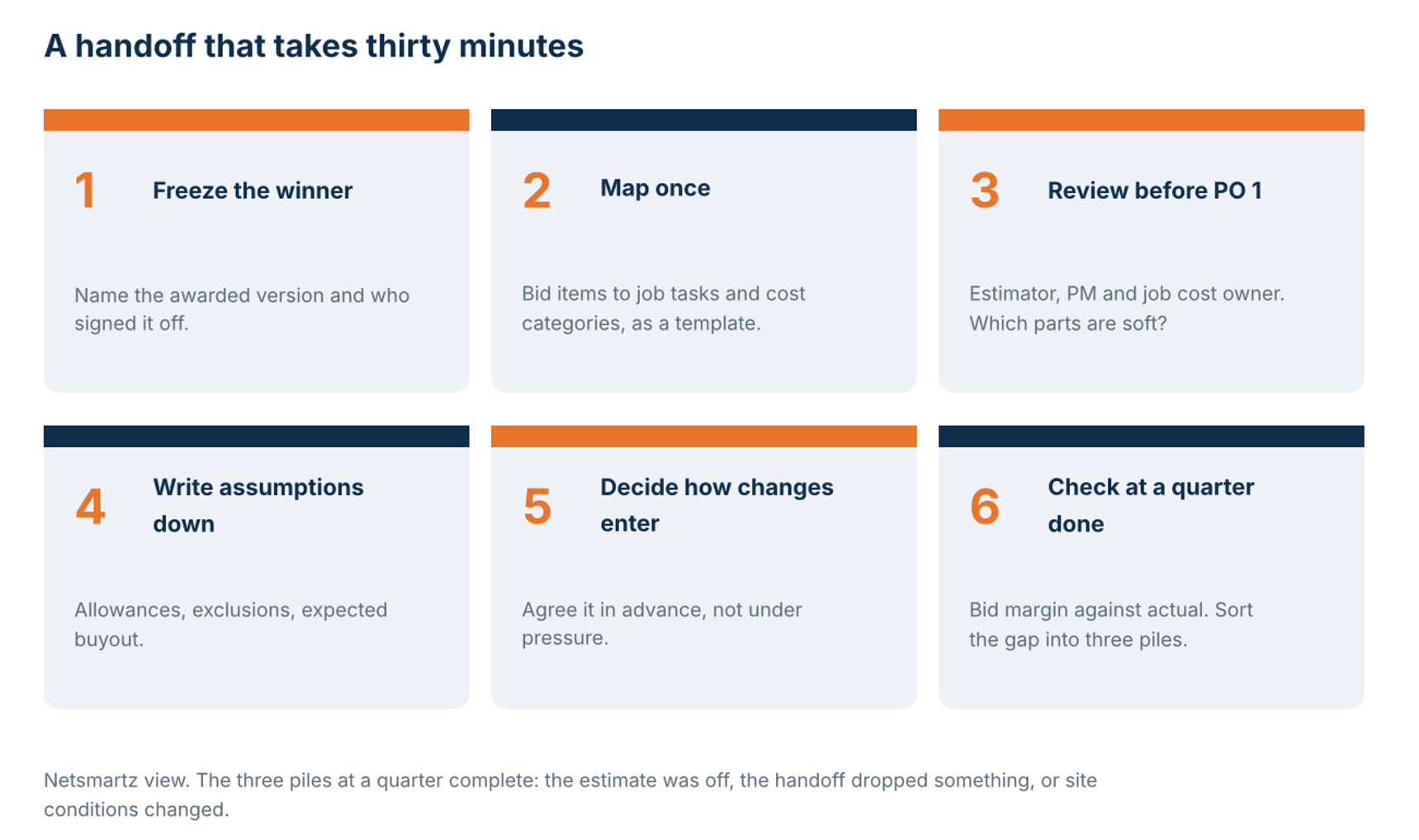
The six steps. Run them whatever you estimate in.
Why the baseline matters in Business Central
ProjectPro is built on Microsoft Dynamics 365 Business Central, so it helps to know how Business Central treats a budget. A project budget is built from planning lines on each task. Every line has a type: Budget, Billable, or Both. The budget is compared with actual usage posted to the project. And according to Microsoft’s documentation, Budget-type usage “is used to calculate WIP.”
So a wrong baseline does not stay on the budget screen. It flows into the WIP schedule, which is a document your bonding company and your bank may ask to see. The handoff is not a back-office detail.

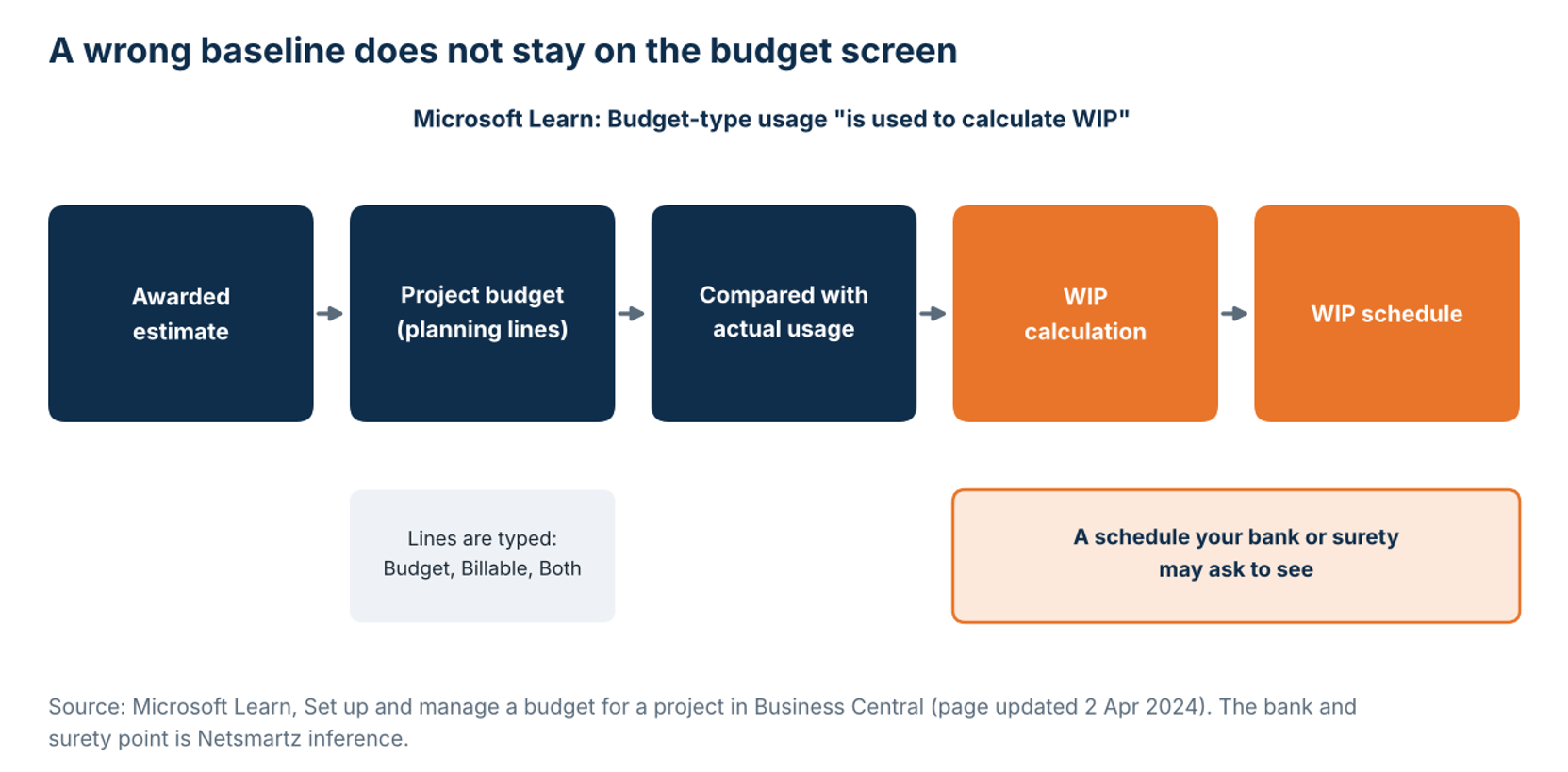
From estimate to WIP schedule. The Microsoft quotation is from Learn; the bank and surety point is our inference.
Where ProjectPro fits
ProjectPro’s job quoting page describes quotes built from bid items, job tasks and assemblies of labor, equipment and subcontract cost. It describes quotes that convert into jobs, and a view of budgeted versus actual cost by bid item. When the quote and the job live in the same system, there is less to retype at award, and retyping is where handoff errors tend to start.
Software can carry the numbers across. Someone still has to say which of them are soft. Run the thirty-minute review either way.
See how a quote becomes a job in ProjectPro
Book a demo and bring your last job awarded. We will walk through how the quote, the budget, and the cost report connect.
FAQs
It is the moment an awarded estimate becomes the operating budget for a job. It is where structure, assumptions and ownership change hands.
Usually the estimate is the starting point. The questions are what has changed since the bid, such as buyout results and scope clarifications, and whether you want to keep the bid margin visible next to a separate operating budget. That is a policy choice, and a good one to make on purpose.
The frozen version of the budget that every later cost report, change order and WIP schedule is measured against. Without one you are comparing actuals to a moving target.
No. The steps above work whatever you estimate.