
Your Best Estimator Retires in Two Years. Is Your Construction Job Costing Software Ready?
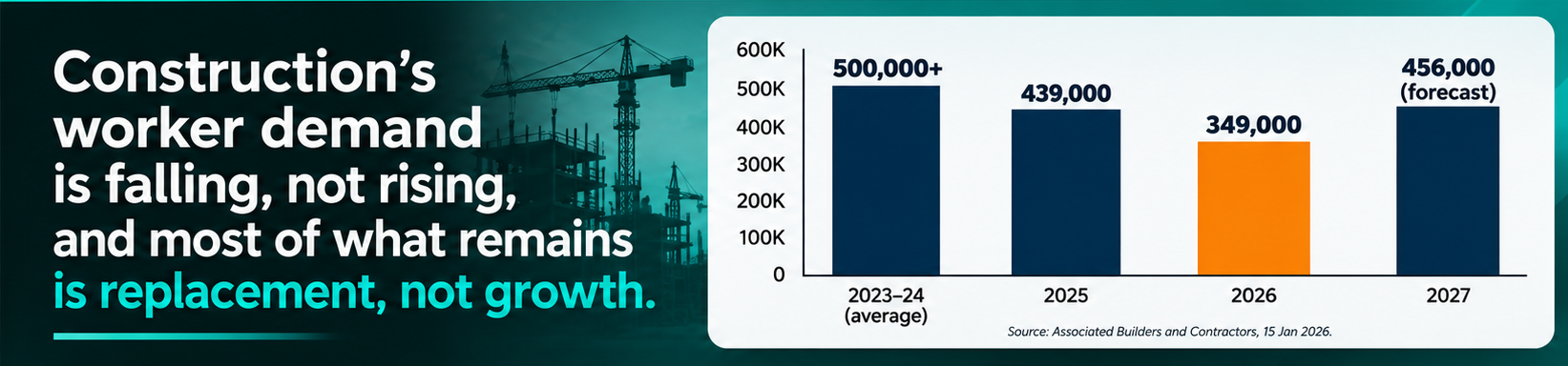
In January 2026, the Associated Builders and Contractors put a number on something most construction executives already sensed: the industry needs 349,000 net new workers this year. That is down sharply from 439,000 in 2025 and more than 500,000 a year in 2023 and 2024. According to ABC’s own chief economist, most of that demand has nothing to do with growth. Construction spending forecasts for 2026 and 2027 are modest. The workers leaving are leaving because they are retiring, not because the industry suddenly needs fewer of them replaced.
That distinction matters more than the headline. A shortage caused by growth is a hiring problem. A shortage caused by retirement is a knowledge problem, and it shows up first in the numbers nobody else is watching.
The Number Nobody’s Putting in the Headline
ABC’s release does not split the 349,000 into field roles and office roles, and this is not an argument that a system replaces a superintendent or closes a jobsite staffing gap. It does not, and nothing here claims otherwise. But estimators, project accountants, and the PM who has run forty jobs and remembers exactly why one of them blew its concrete budget are part of that number too. When they retire, what leaves with them is not labor. It is judgment. That is a different kind of shortage, and unlike the jobsite version, it is one system can do something about.
What Actually Walks Out the Door
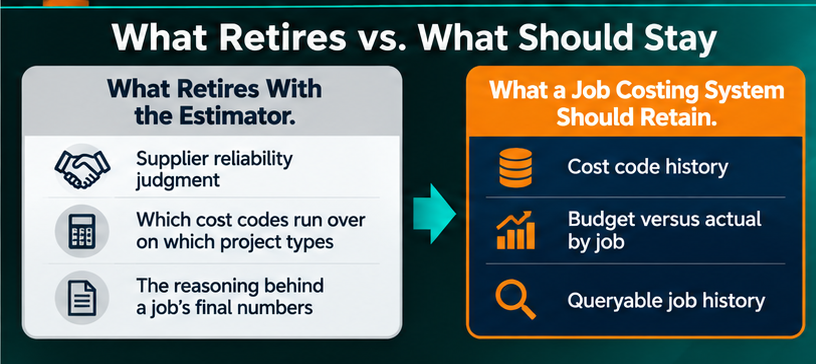
Ask any controller what happens when a twenty-year estimator retires, and the answer is usually the same: estimates get less accurate for a while, and nobody can say exactly why. It is rarely one big piece of missing information. It is a hundred small ones. Which supplier actually delivers on a tight schedule and which one only promises to. Which cost code quietly runs over on renovation work versus new build. Why a specific job’s overhead ran high, and whether that was the job or just a bad year. None of that lives in a resume. Most of it never made it into a system at all. It lived in one person’s head, updated every time they walked a site or closed out a job, and it left when they did.
Why This Shows Up in Construction Job Costing Software First
Construction job costing software is supposed to be exactly where that judgment gets captured instead of lost: cost codes, commitments, budget versus actual, job history that outlives any one person’s memory. In practice, a lot of installations do not work that way. Cost codes get set up once during implementation and never revisited as the business changes. Historical job data sits in a system nobody reports off of, because the reports were built for last year’s project mix. The estimator’s actual reasoning, the “why” behind a number, stays a verbal habit passed to whoever they happen to be training, if anyone is being trained at all.
That gap is invisible right up until the person carrying it retires. Then it is a line item.
What a Job Costing System Actually Has to Do
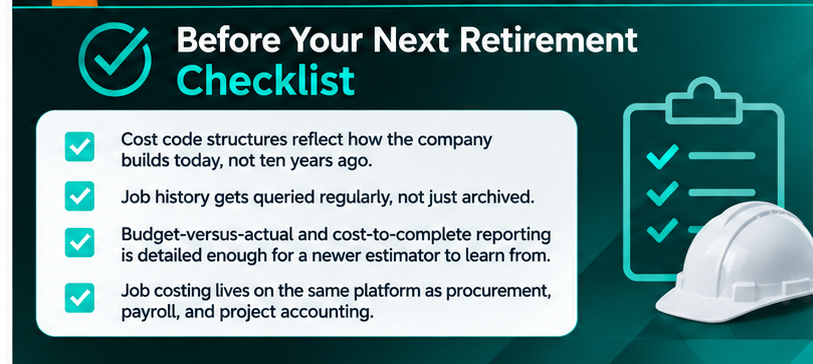
Retaining that judgment is not about writing everything down in a manual, and it is not about AI reading someone’s mind before they leave. It is narrower and more mechanical than that. Cost code structures that reflect how the company actually builds today, not how it built ten years ago. Job history that gets queried regularly, not just archived. Budget-versus-actual and cost-to-complete reporting detailed enough that a newer estimator can learn from it instead of rebuilding the same judgment from scratch. Procurement, payroll, and project accounting living on the same platform as job costing, so the reasoning behind a number has a chance of staying attached to the number itself instead of sitting in a separate spreadsheet only one person ever understood.
This is where ProjectPro’s job costing sits inside Microsoft Dynamics 365 Business Central: procurement, payroll, and project accounting in the same environment as job costing and financial reporting, across budgets, labor, materials, subcontractors, and equipment. That does not replace an estimator’s judgment. It is the difference between that judgment disappearing entirely and most of it staying queryable after the person who built it moves on.
Before the Next Retirement, Not After
The 349,000 figure is a 2026 number, but ABC is already forecasting 456,000 for 2027, so this is not a one-year problem. The practical question for a contractor is not whether to worry about it. It is whether the person retiring next has spent their last few years working inside a system that actually kept what they knew, or working around one that never asked.
If it is the second one, the fix is not a faster hiring process. It is an honest look at whether job costing has been treated as a compliance report or as the actual record of how the company makes money on a job. Those are not the same system, even when they share a login screen.
Next Step
See how ProjectPro’s job costing, procurement, payroll, and project accounting work together on Microsoft Dynamics 365 Business Central.
Schedule a ProjectPro Demo
Frequently Asked Questions
Construction job costing software tracks costs against a specific job or project, organized by cost code, so a contractor can compare budgeted costs to actual costs across labor, materials, subcontractors, and equipment in real time rather than after the job closes.
Because much of what makes an estimate accurate is not in the system. It is unwritten judgment: which suppliers are reliable, which cost codes typically run over on certain project types, and why a specific job’s numbers looked the way they did. When that person leaves, the system is often missing the context behind its own numbers.
According to the Associated Builders and Contractors, most of the 349,000 net new workers needed in 2026 reflects retirements rather than growth in construction spending, which is forecast to rise only modestly. The figure covers the workforce broadly and is not broken out by field versus office roles.
No. It can preserve the data an estimator’s judgment was built on: cost history, cost code accuracy, budget-versus-actual patterns, so a successor has something to learn from. It does not replace the experience of having actually run the jobs.
Cost code structures that reflect current project types, job history that gets actively reported on rather than archived, and job costing that lives on the same platform as procurement, payroll, and project accounting, so the numbers and the reasoning behind them stay connected.