Pull any certificate of insurance from your subcontractor files and read the line printed in capital letters at the top:
“THIS CERTIFICATE IS ISSUED AS A MATTER OF INFORMATION ONLY AND CONFERS NO RIGHTS UPON THE CERTIFICATE HOLDER.”
That’s you. The certificate holder.
A COI does not establish additional insured status, confirm that limits still meet your contract, or prove coverage remains in force today. The industry-standard ACORD 25 form is clear about that. Yet the certificate often becomes the proof because checking what sits behind it, including endorsements, limits, and policy changes, takes time. So, the real check can end up happening when payment is due.
Subcontractor insurance compliance is a continuity problem, not a checkpoint problem. Coverage can change during a project, so compliance has to keep up. That is repetitive, document-heavy work an AI coworker can handle continuously, while your people retain control over the decisions.
Coverage Changes Mid-Project. Your Files Don’t.
A COI shows what coverage looked like when it was issued. During a project, the policy can change through a renewal, a new carrier, a reduced limit, or a missing endorsement. The certificate in your file does not change with it.
That creates the real compliance problem: a certificate that was acceptable six months ago may no longer meet the subcontract’s requirements today. Renewals are a natural point to recheck coverage, limits, and endorsements. Keeping the COI on file is not the same as keeping compliance current.
What Actually Needs Checking (It’s Not Just the Certificate)
A certificate being on file and a subcontractor being compliant are two different things. Here’s where they come apart:
|
Requirement |
What the certificate shows |
What you actually need to confirm |
|---|---|---|
|
Additional insured |
A checkbox marked “Y” |
The endorsement itself, covering ongoing and completed operations as the contract requires (for example, ISO CG 20 10 and CG 20 37, or equivalent wording) |
|
Waiver of subrogation |
Another checkbox |
The endorsement, since the ACORD form itself says some policies require one |
|
Primary and non-contributory |
Usually a line in the description box |
Endorsement wording that actually makes the sub’s policy respond first |
|
Limits (GL, auto, umbrella) |
Limits on the day it was issued |
Current limits after renewal, measured against the contract minimums |
|
Workers’ comp and risk modifiers |
That a policy exists |
The experience modification rate (EMR) against your prequalification threshold |
|
Policy dates |
An expiration date |
Continuous coverage through project completion, plus any completed-operations period the contract requires |
That’s why subcontractor compliance takes so much time when it’s done by hand. The work isn’t collecting certificates. It’s reading endorsements, comparing them against each contract’s requirements, and doing it again every time something renews.
Why Compliance Gaps Surface at Payment Time
Payment often becomes the hardest compliance checkpoint. At onboarding, the focus is getting the sub started. During the job, renewal monitoring can fall between risk, project, procurement, and AP. Then the issue surfaces on pay run day, when the sub is waiting on cash.

That timing creates friction. Billd found that subcontractors wait an average of 51 days to get paid, and 64% report being slow paid by their GC. A compliance hold adds more pressure at an already sensitive point. The opposite mistake carries its own risk. Paying a subcontractor whose coverage has lapsed or fallen below contract requirements can leave the GC carrying risk that the subcontractor’s insurance was expected to address.
The goal is to surface compliance gaps before payment day, not discover them when payment is ready to go out.
Five Steps to Stop Finding Compliance Gaps on Payment Day
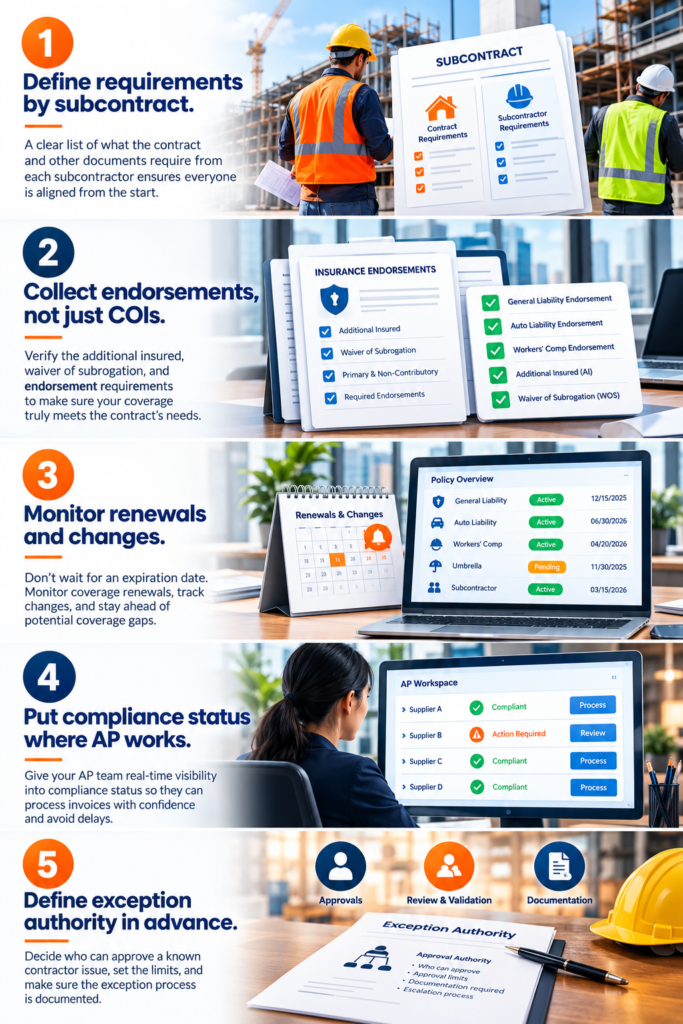
Meet the Construction Risk & Compliance AI Worker
The Construction Risk & Compliance AI Worker keeps subcontractor compliance records current by reading incoming insurance documents, checking them against contract requirements, updating the ERP, and flagging gaps.
People make the decisions. The AI worker does not decide whether to hold payment, approve an exception, or accept a coverage shortfall.
What that looks like
A drywall subcontractor’s policy is up for renewal mid-project, with an $86,400 pay application due at month-end.
- Weeks before expiration, the AI worker flags the renewal.
- The broker sends a new certificate and endorsements. It reads them and finds two gaps: the umbrella dropped from the required $5 million to $2 million, and the completed-operations additional insured endorsement is missing.
- It updates the ERP with the compliance status and flags the risk coordinator and PM.
The team now has weeks to address the gap before payment is due. AP sees the current status when the pay run arrives.
The checking is continuous. The decisions stay with your team.
The Bottom Line
A certificate on file tells you what a sub’s coverage looked like on one day. Subcontractor insurance compliance is about every day after that. When compliance is checked continuously and lands where payments are made, payment day becomes routine instead of a scramble, and your company isn’t carrying risk nobody knew about.
See how the Construction Risk & Compliance AI Worker keeps subcontractor compliance current, so payables can pay with confidence. Book a demo.
FAQs
Subcontractor insurance compliance means confirming that each subcontractor and vendor carries the insurance their contract requires: the right coverage types, limits, and endorsements (such as additional insured and waiver of subrogation), in force for the whole period the contract requires. It isn’t a one-time check, because policies renew, change, and get cancelled during a project.
No. The standard ACORD 25 certificate states that it is “issued as a matter of information only and confers no rights upon the certificate holder,” and that it does not amend, extend, or alter the coverage in the policies. Additional insured status and waivers of subrogation depend on the policy’s actual endorsements.
Both are common ISO additional insured endorsements. CG 20 10 generally applies to ongoing operations, while the work is being performed. CG 20 37 applies to completed operations, after the work is finished. Many construction contracts require both, so check what your contracts specify.
That depends on your subcontract terms and applicable law, so check with your legal and risk advisors. What matters operationally is that accounts payable knows a sub’s compliance status before the pay run, not after, so any decision to hold, pay, or approve an exception is made deliberately.
No. It validates documents, keeps compliance records current, updates the systems that need to know, including the ERP, and flags risk. Your team decides whether to hold a payment, request a corrected certificate, or approve an exception.